NGHT: The Bitcoin ETF Built to Capture Overnight Gains

Bitcoin trades around the clock, but the U.S. stock market does not — and the research behind one unusual new fund argues that this gap is where much of Bitcoin’s return actually lives. The Nicholas Bitcoin and Treasuries AfterDark ETF was built around exactly that idea: hold Bitcoin-linked exposure while Wall Street sleeps, then step aside into short-term U.S. Treasuries once the opening bell rings. What began as a regulatory filing for a proposed fund is now a live product, and it offers one of the clearest tests yet of whether Bitcoin’s overnight edge is real, repeatable, and worth paying for.
Quick Takeaways
- The Nicholas Bitcoin and Treasuries AfterDark ETF trades on the New York Stock Exchange under the ticker NGHT, launched by Atlanta-based asset manager XFUNDS by Nicholas Wealth on April 8, 2026.
- The fund takes Bitcoin-linked exposure — via futures, options and other ETFs — overnight, and holds cash and short-term U.S. Treasuries during the trading day. It does not hold spot Bitcoin directly.
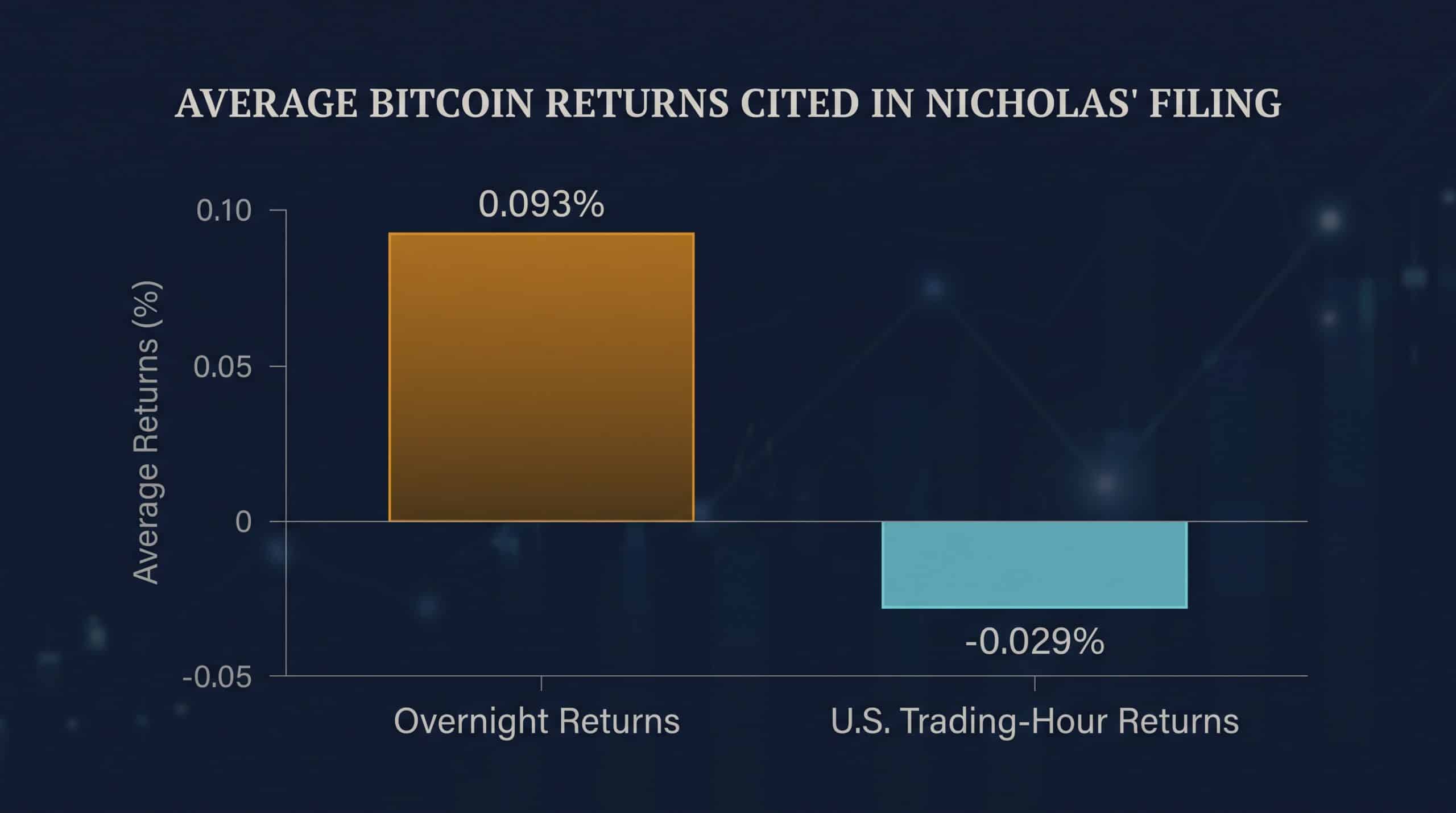
- Empirical work cited in Nicholas’ filing places average overnight returns near 0.093%, compared with -0.029% during U.S. trading hours.
- Analysts are split on whether the overnight pattern is durable or simply noise, which makes consistency the central question for the strategy’s long-term success.
From Filing to Launch: The Nicholas Bitcoin and Treasuries AfterDark ETF
The fund’s paper trail starts at the Securities and Exchange Commission. The SEC filing, covered in December 2025, describes a strategy utilizing Bitcoin futures during overnight hours and closing positions after U.S. markets open each trading day. Reporting on the filing also names Tidal Trust and Nicholas Financial Corporation as involved in proposing the AfterDark strategy, which was pitched from the start as a way to isolate the part of Bitcoin’s return that shows up while U.S. exchanges are closed.
The product itself arrived a few months later. Atlanta-based asset manager XFUNDS by Nicholas Wealth launched the Nicholas Bitcoin and Treasuries AfterDark ETF (NYSE: NGHT) on April 8, 2026. Behind the brand is Nicholas Wealth Management, a registered investment adviser that positioned the fund as long Bitcoin exposure during overnight hours paired with short-term U.S. Treasuries and cash equivalents during daytime trading.
David Nicholas, president and founder of Nicholas Wealth, believes the fund will outperform, especially during bull markets for Bitcoin. For investors who have been unhappy with Bitcoin’s recent performance, an actively managed, time-based strategy of this kind may hold obvious appeal: it promises exposure to the asset’s historically strongest hours while sitting out the sessions where returns have been weakest.
How the AfterDark Strategy Works
The mechanics are a daily rotation with two legs. Around 4:30 p.m. ET, the fund shifts into Bitcoin exposure — via futures, options and other ETFs — and then exits those positions the next morning before the market opens. During daylight hours it holds cash and U.S. Treasuries, an allocation intended to dampen volatility while U.S. equities are trading.
One detail matters for anyone comparing this product with spot Bitcoin funds: the ETF does not hold spot Bitcoin directly. Exposure comes through Bitcoin-linked instruments rather than coins held in custody, which changes both the risk profile and the way the fund tracks the underlying asset.
Bloomberg described the fund as built to ride the overnight pattern: buy Bitcoin at the market close, sell before the open, and invest in Treasuries during the day. That framing captures the bet in a single sentence — the fund is not so much a view on Bitcoin’s direction as a view on when Bitcoin moves.
The Research Behind the Overnight Trade
The premise did not come from nowhere. An analysis of five-minute bitcoin price data from January 2018 to December 2023 indicated that average overnight returns were better than U.S. trading hour returns. That pattern suggests higher buying activity overseas during U.S. off hours, a structural feature of a market that never closes even when its largest pool of institutional participants goes home.
The fund’s own paperwork leans on similar evidence. Empirical work cited in Nicholas’ filing places average overnight returns near 0.093%, compared with -0.029% during U.S. trading hours. The same figures anchor analysis of the fund’s time-based approach, which treats overnight outperformance as the entire engine of the strategy.
Averages, however, are not guarantees. A small positive average across thousands of overnight sessions can coexist with long stretches where the pattern weakens, disappears, or reverses — and a fund built entirely around that pattern has no second engine to fall back on if it does.
The Skeptics’ Case
Not everyone is convinced the pattern means anything. Greg Magadini, Director of Derivatives at Bloomberg, has said there shouldn’t be any reason for Bitcoin to consistently outperform or underperform overnight — in other words, the overnight edge may simply be noise that happens to show up in a particular historical window.
That objection goes to the heart of the product. If overnight outperformance is a durable structural feature, a time-sliced fund can harvest it year after year. If it is an artifact of one market regime, the strategy inherits all of Bitcoin’s overnight risk without a reliable premium to show for it. Inconsistent outperformance is the single biggest question mark hanging over the fund’s long-term success.
Risks, Pricing and Fund Mechanics
As an actively managed fund, the portfolio manager has discretion in making investment decisions and selecting the underlying assets. The fund’s investment objective is total return, and it invests in bitcoin futures contracts, which can be subject to market volatility.
Shares of ETFs are bought and sold at market price, which may be worth more or less than net asset value, and are not individually redeemable directly with the fund. Shares may trade at a premium or discount to their net asset value. Unlike mutual funds, ETFs are bought and sold throughout the day. Investing involves risk, including the potential loss of principal. Additional risks can be found in the fund’s prospectus. Distributed by Foreside Fund Services.
The Evolving ETF Landscape
NGHT arrives in the middle of a period of constant product innovation. The blurring of lines between ETFs and mutual funds, particularly through share class changes, is a notable industry trend, and active strategies are claiming a growing share of investor attention. Adoption of active ETFs has increased, with assets under management growing substantially in 2024.
Digital assets are playing a more prominent role as well. The launch of spot Bitcoin and Ethereum ETFs has the potential to change how many investors approach the digital asset class, and the ongoing expansion of digital assets and active strategies is reshaping how investors think about portfolio construction and asset allocation. A night-only Bitcoin fund is a natural — if aggressive — extension of both trends at once.
Competition and Market Dynamics
The ETF market is becoming increasingly competitive as more asset management firms enter the space. Popular ETFs like VOO, IVV, and SCHD continue to attract significant investment by offering diversified exposure at low costs, which makes them attractive to both retail and institutional investors. Against that backdrop, a specialized product like NGHT competes not on cost or breadth but on a specific, testable thesis.
The growing number of active ETFs also means investors face more choices than ever, and with them the need for careful evaluation of which funds actually align with their investment objectives rather than simply sounding novel.
Reading Market Sentiment
Overall market sentiment toward Bitcoin remains cautiously optimistic, and Bitcoin’s trading volume can shift significantly on regulatory news and macroeconomic indicators. Analyst sentiment on the overnight thesis is divided, with some pointing to the potential for overnight outperformance and others questioning its consistency. The fund’s actively managed nature and limited historical data add further uncertainty.
Timing patterns can still be informative context. If the stock market is down while Bitcoin volume is up, for example, that can signal investors hedging their portfolios — exactly the kind of cross-market behavior a session-based strategy is trying to capture.
Frequently Asked Questions
Which ETF does Warren Buffett suggest?
Warren Buffett has often recommended low-cost S&P 500 index funds, such as VOO, as a core holding for most investors.
What ETF will boom in 2026?
Predicting the exact ETF to boom in 2026 is speculative, but given current trends, ETFs focused on emerging technologies like AI, and those providing access to alternative assets like private credit, may experience significant growth.
What is an ETF in simple terms?
An ETF is like a basket holding many different stocks or bonds. Instead of buying each one separately, you buy one share of the basket, giving you instant diversification.
Why does Dave Ramsey say not to invest in ETFs?
Dave Ramsey typically advises against investing in anything other than well-diversified mutual funds with a long track record of success, actively managed by a proven investment team. He often cites the potential for hidden fees and the complexity of some ETFs as reasons for his stance.
Conclusion
The Nicholas Bitcoin and Treasuries AfterDark ETF represents a genuinely different way to hold Bitcoin risk — not more of it or less of it, but a specific slice of the clock. The research behind it, with average overnight returns near 0.093% against -0.029% during U.S. trading hours, is documented in the fund’s own filing, but so is the disagreement about whether that spread will persist. Investors should weigh the risks carefully, consider the inconsistent nature of Bitcoin’s trading patterns, and align any position with their individual risk tolerance and financial goals. Now that NGHT is trading on the NYSE, the overnight thesis finally has a live scoreboard — and whether investors who have been unhappy with Bitcoin’s recent performance will embrace a night-shift version of the asset remains to be seen.