The 2026 Safe Haven Showdown: Bitcoin vs Gold

Every stretch of market turbulence revives the same question: when uncertainty spikes, is your money safer in gold or in Bitcoin? For years that debate ran mostly on theory and ideology. In 2026 it has been running on hard evidence, because markets delivered genuine stress — trade threats, armed conflict, and a broad rotation back into risk assets — and both would-be safe havens were forced to show what they actually do under pressure.
What Makes an Asset a Safe Haven
A safe haven is an asset that investors expect to hold or grow its value while other markets are falling. When economies wobble, capital flows toward whatever feels most likely to survive the storm, and the assets that consistently attract those flows earn the label.
Gold earned it the traditional way. During the 2008 financial crisis, gold prices rose as stocks fell, reinforcing a reputation built over centuries of monetary history. Bitcoin’s claim is newer and more contested: its supporters argue that a scarce, decentralized digital asset should behave like gold in a crisis, while skeptics point to its short track record and dramatic price swings. What sets 2026 apart is that investors no longer have to argue in the abstract — the year has produced real-world results.
How 2026 Has Actually Played Out
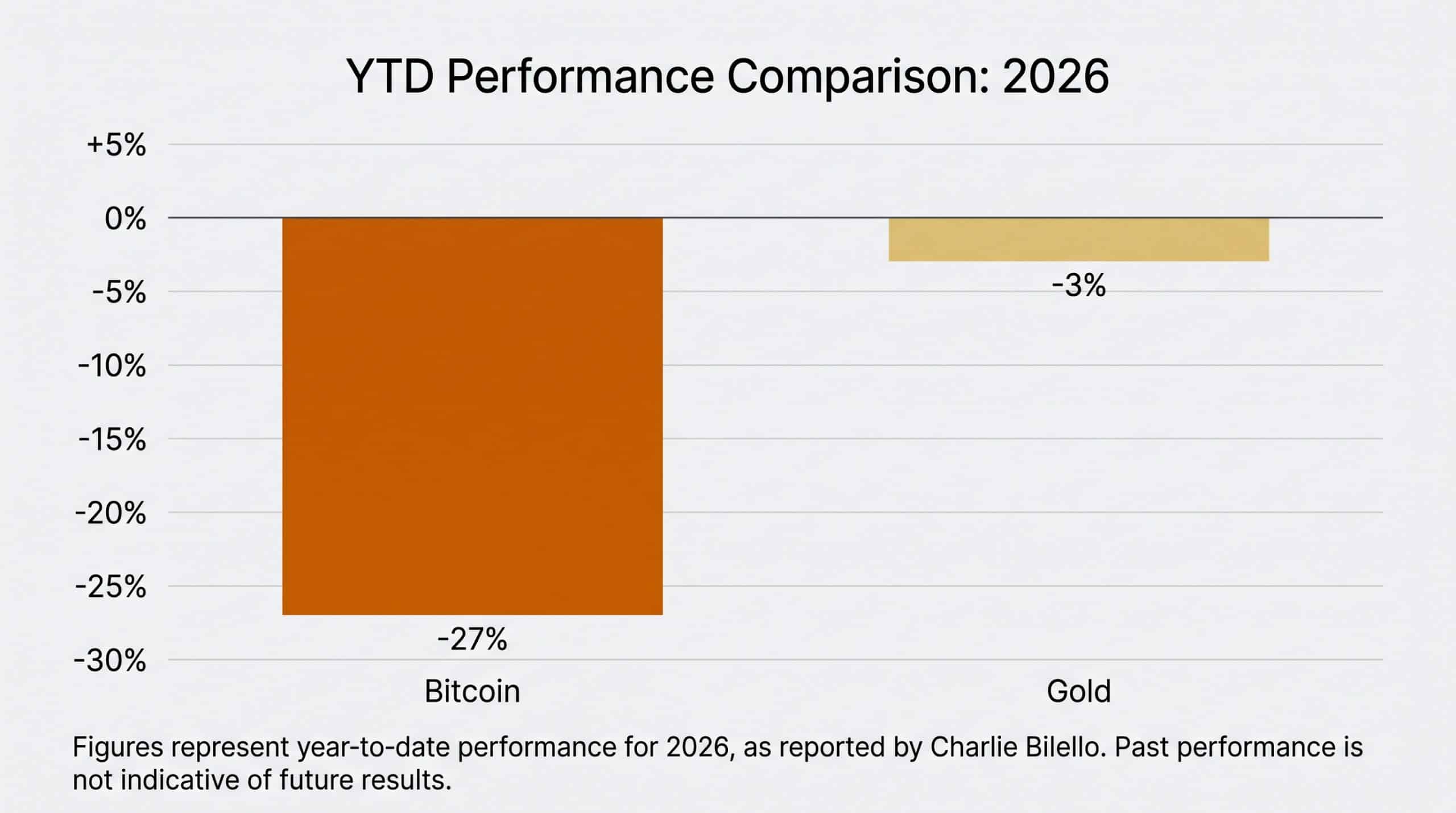
The headline numbers have been humbling for both camps. Bitcoin was down about 27% year to date in 2026, while gold was down about 3%, according to Charlie Bilello, as cited by Yellow and Crypto.news. Crypto.news notes that Bitcoin and gold are the only major asset classes in the red for 2026, with the weakness driven by rotation, mean reversion, a stronger dollar, and higher real yields — and it argues that Bitcoin’s digital-gold thesis is being stress-tested, not fully disproven.
The gap between the assets showed up early in the year. CoinDesk reported that since January 18, 2026, when Donald Trump initially threatened tariffs in pursuit of Greenland, Bitcoin fell 6.6% while gold rose 8.6%, nearing $5,000. Faced with the same geopolitical shock, the assets moved in opposite directions.
The Geopolitical Stress Test
Forbes reported that the Iran conflict began on February 27, 2026, and described it as a “real-time stress test” for the safe-haven claims of both gold and Bitcoin.
Forbes’ reading of the results is worth sitting with: the 2026 evidence showed gold acting as a store of value and a hedge against institutional confidence erosion, while Bitcoin acted as high-beta exposure to digital scarcity. On that framing, the real question is less about which asset wins the safe-haven title and more about what job you are hiring each asset to do — buying protection, or buying amplified exposure to a long-term scarcity thesis.
Volatility: The Numbers Behind the Debate
Volatility is where the assets differ most. According to Bybit, Bitcoin has delivered substantially higher raw returns than gold over 5- and 10-year periods, but with annualized volatility of roughly 60-80% compared to gold’s 12-15% — a spread that makes the risk-adjusted comparison much closer than headlines suggest.
That volatility cuts both ways. In August 2026, Bitcoin surged from approximately $70,000 to over $77,000 while gold hit a 3-month high, according to Bybit. Sharp rebounds are as much a part of the Bitcoin experience as sharp drawdowns — which is why investors seeking stability have historically leaned toward gold, while investors seeking growth have accepted Bitcoin’s swings as the price of admission.
What Analysts Forecast for Gold
Institutional forecasts for gold remain constructive. AInvest reports that HSBC forecast gold at $5,050 per ounce by mid-2026, while J.P. Morgan forecast $5,200-$5,300 per ounce by year-end 2026. Forecasts are opinions, not guarantees, but they show where major banks see the metal heading in an environment that has favored it.
Institutional Adoption and Investor Sentiment
Bitcoin’s case does not rest on price action alone. Companies including MicroStrategy and Tesla have invested in Bitcoin to hedge against inflation and currency devaluation, and that corporate presence has made the asset more familiar to traditional investors than it was in earlier cycles. Younger investors in particular tend to treat Bitcoin as a natural part of a diversified portfolio rather than an exotic bet.
Sentiment matters because safe-haven status is partly self-fulfilling: an asset protects wealth in a panic only if enough investors believe it will and act on that belief. Gold has centuries of that belief behind it. Bitcoin is still building its base, and years like 2026 test how deep that belief runs.
Physical Metal vs. Digital Scarcity
The practical differences between the assets still matter. Gold is tangible: you can hold it, vault it, and rely on the fact that it depends on no network or company to exist. During the economic crisis in Venezuela, gold stood strong, which is exactly the kind of episode that keeps its reputation intact.
Bitcoin’s advantages are mobility and access: it is easy to move and to hold without physical storage, and it is not tied to any single country. Neither profile is strictly better — they solve different problems, which is why a growing number of investors now use both rather than choosing a side.
Tools for Evaluating Both Assets
If you want to track this contest yourself, lean on data rather than headlines. For Bitcoin, platforms such as CoinMarketCap and Glassnode offer live market data and analytics. For gold, the World Gold Council publishes price histories and market trend research. Comparison tools such as CompareGold and Bitcoin Calcs let you put both assets side by side when weighing an allocation.
Making an Informed Decision
The 2026 evidence points to a conclusion that is less dramatic than either camp’s marketing: gold and Bitcoin are different tools. Gold has behaved like the classic crisis hedge — steadier, favored during geopolitical shocks, and backed by constructive bank forecasts. Bitcoin has behaved like a volatile asset with a scarcity story — capable of sharp rallies, but prone to deep drawdowns when investors rotate back toward stocks and the dollar strengthens.
Your choice should follow your goals. If your priority is preserving value through shocks, the year’s data favors gold. If you can tolerate volatility for exposure to digital scarcity, Bitcoin offers it — with all the swings that entails. And if you do not want to pick a side, holding both is itself a strategy many investors now use. Whatever you decide, anchor the decision to current data and your own risk tolerance rather than to slogans.
FAQ
What defines a safe haven asset?
A safe haven keeps or grows its value when broader markets are unstable. Investors turn to these assets during economic downturns and geopolitical crises.
Which asset has performed better in 2026?
Gold. Bitcoin was down about 27% year to date in 2026 while gold was down about 3%, according to Charlie Bilello as cited by Crypto.news — a wide gap, even though both assets have been weak.
Does 2026 disprove Bitcoin’s digital-gold thesis?
Not necessarily. Crypto.news describes the thesis as being stress-tested, not fully disproven, with the weakness driven by rotation, mean reversion, a stronger dollar, and higher real yields.
Should I hold gold, Bitcoin, or both?
That depends on your goals and risk tolerance. Gold suits investors who prioritize stability; Bitcoin suits those who accept volatility in exchange for growth potential; and many investors now hold both to balance the profiles against each other.