Bitcoin Price Prediction 2026: What Analysts Expect

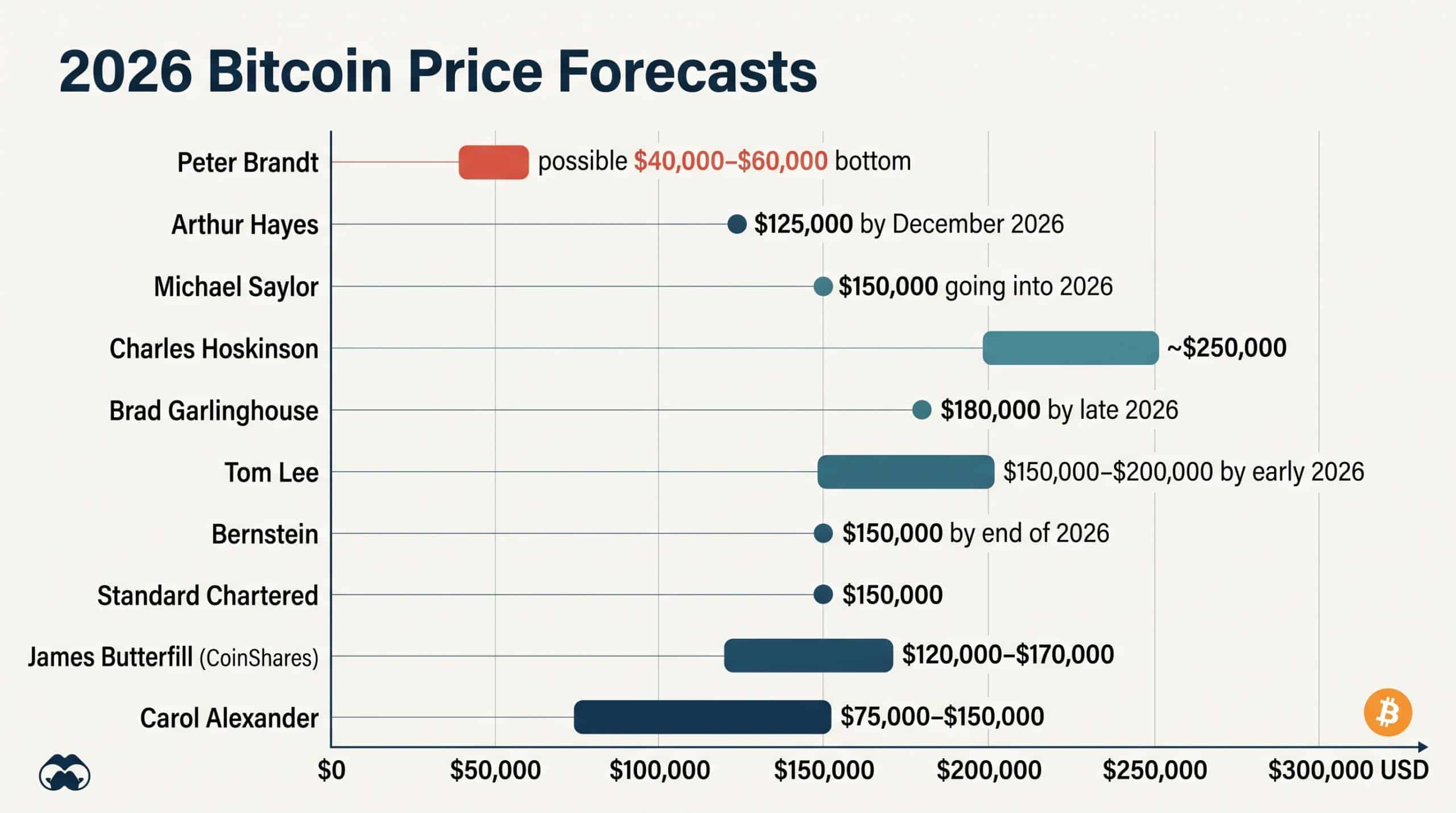
Bitcoin enters 2026 with named forecasts further apart than at almost any point in recent years. Veteran trader Peter Brandt has warned of a potential $40,000 to $60,000 bottom by fall 2026, while Cardano founder Charles Hoskinson has projected the price at around $250,000. Between those extremes, most bank and institutional targets sit in six figures, and prediction markets price in more cautious outcomes. Here is what named analysts, executives, and markets currently expect for the bitcoin price in 2026, and the structural forces behind their forecasts.
Quick Takeaways
- Industry executives and investors forecast a wide range of prices for bitcoin in 2026, dropping as low as $75,000 and rising as high as $225,000.
- Bank forecasts cluster near $150,000: analysts at Standard Chartered and Bernstein have said bitcoin could reach around $150,000 by the end of 2026.
- Prediction markets are more cautious, with Kalshi’s end-of-2026 market concentrating the most probability in the $60,000 to $70,000 range.
- Institutional adoption, spot bitcoin ETFs, and macro conditions remain the key factors influencing the price of bitcoin.
The Full Range of 2026 Bitcoin Price Predictions
Publicly available price predictions for 2026 vary widely. CNBC reports that industry executives and investors see bitcoin anywhere from $75,000 to $225,000 this year. Carol Alexander, professor of finance at the University of Sussex, expects bitcoin to stay in a “high-volatility range” of $75,000 to $150,000 in 2026, with the “centre of gravity around” $110,000. These forecasts reflect diverse perspectives on what bitcoin could achieve, so it helps to group them by who is making the call.
Bank and Institutional Forecasts
- Standard Chartered forecasts $150,000 for bitcoin in 2026, a target CNBC reports was cut from a prior $300,000 call in December.
- Bernstein analysts expect bitcoin to reach $150,000 by the end of 2026 and $200,000 by the end of 2027.
- Forbes notes that Standard Chartered and Bernstein have both pointed to around $150,000 by the end of 2026, and that a Yahoo Finance aggregation of analyst estimates lists projections near $170,000 for 2026.
- James Butterfill, head of research at CoinShares, expects bitcoin to trade between $120,000 and $170,000 in 2026, with “more constructive price action” likely in the second half of the year.
- Grayscale predicts a new bitcoin all-time high in the first half of 2026, driven by institutional adoption.
Crypto Executives and Traders
- Tom Lee, head of research at Fundstrat and chairman of Bitmine, has said bitcoin will be between $150,000 and $200,000 by early 2026, after previously repeating a $250,000 target.
- Brad Garlinghouse, CEO of Ripple, projects bitcoin at $180,000 by late 2026.
- Charles Hoskinson, founder of Cardano, has projected bitcoin at around $250,000 in 2026.
- Michael Saylor, executive chairman at Strategy, predicts $150,000 going into 2026; prediction roundup coverage also lists him at $1 million as a long-run call.
- Arthur Hayes, BitMEX co-founder and chief investment officer at Maelstrom, said at Bitcoin Vegas 2026 that he sees bitcoin reaching $125,000 by December 2026.
- Peter Brandt warns of a potential $40,000 to $60,000 bottom by fall 2026, before a later cycle peak near $500,000 in 2029.
What Prediction Markets Say
Betting markets offer a probability-weighted view rather than a single target. Kalshi’s long-horizon “price at end of 2026” market, which slices possible outcomes into $5,000-wide bands, shows the most probability concentrated in the $60,000 to $70,000 range, with the $60,000–$64,999.99 and $65,000–$69,999.99 bands each priced at roughly 10% implied probability. That is a notably more cautious picture than most named analyst targets, and it underlines how much disagreement remains about where bitcoin finishes the year.
Factors Influencing the Price of Bitcoin in 2026
Several factors recur across forecasts for 2026. Institutional adoption is key, with spot bitcoin ETFs and traditional financial institutions sustaining capital inflows. Supply dynamics — the constraints that follow each halving — remain a core element in valuation models. Interest rate policy, liquidity, and risk asset correlations also continue to shape how analysts frame bitcoin’s price trajectory. Understanding these dynamics matters more than any single headline number, because most forecasters attach conditions to their targets: the “more constructive price action” Butterfill describes, for example, is something he expects in the second half of the year.
Cycle Models and On-Chain Data Analysis
Some analysts use on-chain and cycle-based frameworks to make sense of recent price movements. One analyst described 2025 as a distribution phase following bitcoin’s move above $100,000: prices moved sideways as liquidity deepened, and long-term holders took profits without disrupting the market. That helps explain why consolidation can persist after major price thresholds even while long-term adoption trends stay intact. On-chain data is best used to contextualize consolidation after major milestones rather than as a basis for precise price targets.
Bitcoin Price Forecast: Bearish, Mid-Range, and Bullish Scenarios for 2026
Bearish: Peter Brandt’s warning of a possible $40,000 to $60,000 bottom by fall 2026 anchors the downside, and Kalshi traders currently weight the $60,000 to $70,000 range most heavily.
Mid-range: Several institutional analysts see bitcoin trading between $120,000 and $170,000, with Standard Chartered and Bernstein around $150,000 by the end of 2026 and Carol Alexander’s “centre of gravity around” $110,000.
Bullish: Tom Lee’s range reaches $200,000 by early 2026, Charles Hoskinson projects around $250,000, and Grayscale expects a new all-time high in the first half of 2026. The long-term bitcoin outlook remains positive, though volatile.
Institutional Adoption and the Changing Market Cycle
The price of bitcoin is now less likely to be shaped by pure speculation and more by macroeconomic conditions, institutional inflows, and regulatory clarity. Volatility over the year is expected to come from institutional behavior and financial products, including ETF flows, and the growing use of bitcoin as a corporate treasury asset. As bitcoin moves deeper into institutional markets, the key question for 2026 is how those institutions choose to deploy capital, rather than whether the asset itself continues to gain adoption.
Frequently Asked Questions
What is the most bearish named bitcoin prediction for 2026?
Peter Brandt has warned of a potential $40,000 to $60,000 bottom by fall 2026. Kalshi’s end-of-2026 betting market is similarly cautious, concentrating the most probability in the $60,000 to $70,000 range.
Will bitcoin hit $500,000?
Not in 2026, according to the named forecasts above: the highest 2026 targets covered here sit around $250,000. Peter Brandt has, however, pointed to a possible cycle peak near $500,000 in 2029.
How much will $1 of bitcoin be worth in 2030?
Predicting the exact value is impossible and projections vary widely, but if bitcoin reaches $500,000 by 2030, $1 of bitcoin today would be worth approximately $5.56.
What does Warren Buffett say about bitcoin?
Warren Buffett has been a long-time critic of bitcoin, arguing it has no intrinsic value, and he has consistently advised investors to stay away from it, treating it as a speculative asset rather than a productive one.
Conclusion
The long-term bitcoin story remains compelling: spot bitcoin ETFs are changing the game, institutional participation is likely to continue, and bitcoin’s role as a store of value is a growing part of the thesis. The forecasts above disagree sharply on price — from $40,000 to $60,000 lows to $250,000 highs — but they broadly agree that further institutional interest will be vital, and that 2026 is poised to be a year of consolidation and strategic positioning in the cryptocurrency market.